

The business of "Eurosummer"
Is seasonal luxury hospitality a durable business?

Hello everyone
Thank you for your feedback on July’s podcast episode featuring Gilda Perez-Alvarado, CEO of the new darling on the hospitality scene, Orient Express. She’s also the Group Chief Strategy Officer of Accor, with a hotel real estate background, and therefore brings a unique perspective to the development of the Orient Express brand. If you’ve stayed at an OE property or have gone on the yacht or train, I’d be interested in hearing about your experience. Feel free to DM me on Instagram or direct reply to this email.
Today’s letter is written in collaboration with Dorsia, a long-time partner of The Stanza. While Dorsia is known as the app that gets you access to impossible tables and events, what’s interesting is the tech they’re building to support restaurants and members clubs. As Dorsia partners with several successful venues in key markets around the world, one could say that they have access to interesting data and insights worth nerding out over.
Enjoy,
Nadine
In today’s newsletter:
What’s the key to running a profitable beach club business that has guests returning every summer? Alexandre Rossoz of Loulou Restaurants shares insights from the successful Loulou Ramatuelle
What makes a resort market sticky? Marc Lotenberg of Dorsia discusses the common thread between resort markets that maintain durability
Read previous issues of The Stanza here.

SEEKING BOUTIQUE HOTEL OPERATOR, ZELL AM SEE, AUSTRIA
Schloss Prielau is a historic castle hotel with 10 keys on the shores of Lake Zell in Austria’s Salzburg region — one of the few genuinely rare assets in the alpine luxury market that is available to operate right now.
The property is fully permitted and operational, with an adjacent restaurant, and is available under a lease arrangement. There is no construction timeline, no planning process, and no repositioning required from the ground up. If you’ve been wanting to operate a boutique hotel, this would be a direct path into one of Austria’s most compelling leisure destinations — a market that draws demand year-round across ski season, summer hiking, and various cultural events such as the International Porsche Days and the FAT Ice Race.
The owner is looking for an independent operator or boutique hotel group with the appetite and capability to take on a property of this character.
Asking lease: €15,000 net / monthly
Target room rates: between €300 - €700 contingent on room type and season.
Room mix:
1 Suite with 3 bedrooms (one whole floor)
1 Suite with 2 bedrooms
7 double rooms (differing in size due to the layout of the old house)
1 small extra hut with a double bed
To see photos and inquire, click here.
Advertise with The Stanza Classifieds: via classifieds@thestanzamedia.com.


For today’s letter, I spoke to Marc Lotenberg, founder of Dorsia, and Alexandre Rossoz, Group Managing Director of Loulou Restaurants. (And yes, you can book Loulou Ramatuelle on Dorsia — use code THESTANZA to access.)
I hope you enjoy this letter somewhere at the beach.
The Business of “Eurosummer”
One of the best perks of going to university in London as an American was experiencing pre-Brexit “Eurosummer”. It wasn’t even called that back then, but essentially it was the same act of cycling through the usual Mediterranean resort destinations, and basking in long rosé-fueled lunches by the sea accompanied with incredible people watching (always bring opaque sunglasses so no one catches you staring). Back then, social media and “content” weren’t the modus operandi and therefore the “Eurosummer” tradition was much less of a status symbol than it is today. It was simply just the feeling of freedom and relief after exams were over. Now, in a post-pandemic world where revenge travel has yet to slow down, the beach restaurants that anchor the “Eurosummer” tradition have become cultural institutions seemingly taken over by (mostly) Americans who refuse to skip a Mediterranean summer at all costs.
As an adult with a fully developed pre-frontal cortex, every time I’m at one of these places, I find myself doing the mental math to figure out how much they’re making per day. I always come to the same conclusion, that these hotspots must be making quite a bit, even if people are generally drinking less these days. I’ve also concluded that the reason why “Eurosummer” continues to gain popularity as an annual tradition is the feeling of leisure people get from it: who doesn’t love long lunches by the glittering turquoise sea with friends and family?
“Eurosummer” is now practically half the year
Most people misread the demand side of seasonal luxury and assume that a summer market is a race to fill a three-month window. What Marc sees in the data says otherwise: “The durable markets are the ones outgrowing their season,” he told me, and the case study he reaches for is Ibiza. It used to trade June through August, then May to September, and now April to October, with a resident cohort staying year-round. With the rise of flexible lifestyles post pandemic, several leisure markets that were once operating during a short window have dissolved the notion of a fixed season.
Cultural tentpoles do a lot of the work of stretching the calendar and locking in repeat demand. Monaco has the Grand Prix and the Yacht Show. Cannes has the film festival, AmfAR, and Lions. Dorsia’s members plan around that calendar, and the same names come back for the same moments year after year. Seasonality, then, isn’t the fixed constraint it’s taken to be. In the strongest markets it’s a variable that the best operators and the smartest municipalities are actively lengthening.
It may seem counterintuitive that in the “Eurosummer” game, longevity is earned through restraint
Marc’s account of why some markets keep their guests and others lose them has nothing to do with product and everything to do with restraint. “Long-term success comes from consistency, not gouging,” he said. He watched Mykonos and Saint-Tropez both go through the same cycle years ago, prices creeping up as the markets got busier, guests starting to feel taken for granted, and a slice of them simply leaving for somewhere that hadn’t yet learned to overcharge. Both markets, in his telling, “sobered up.” Ibiza, he thinks, is on the edge of that same test now.
Alexandre runs the site-level version of exactly this discipline. Loulou has spent two years resisting price inflation on Pampelonne, where most operators charge what the market will bear. There is no minimum spend. "Forcing spend is the fastest way to kill the energy and atmosphere we're actually chasing," he said. While a growing share of the beach leans into pure spectacle, Loulou stayed what he calls restaurateurs first. His line for it is one I keep coming back to: "The party should happen because people had a great meal, not instead of one." That shows up in who fills the tables. The first seating is casual and busy and includes families, and the second eases into something more festive as lunch winds down. The payoff isn't sentimental — refusing the squeeze is what has given Loulou a rock-solid first seating and strong shoulder-season months, the exact stretches where less patient operators are already half-empty.
The venues that compound are the ones that decline to charge everything they could. Restraint isn’t a brand value here. It’s the reason that a market or an operator is built to last more than a handful of summers.
What makes a beach restaurant profitable within weeks?
Ask a generalist why they’d steer clear of a seasonal restaurant and they’ll say the short season, the weather, or the risk of a business that only breathes for a quarter of the year. However, the unit economics don’t always corroborate that concern. “A seasonal site and a year-round Paris restaurant actually land at roughly the same EBITDA margin,” Alexandre told me, and Loulou’s seasonal margin is sometimes slightly higher. That surprises people, but it shouldn’t once you see how the cost base is built.
Two things make it work. The first is that Loulou has a nearly zero fixed cost base prior to opening such that all costs are variable. Suppliers in Ramatuelle and Monaco are themselves seasonal, so the costs that would sit on a year-round P&L simply don’t exist out of season. What Loulou carries through the winter is minimal, some storage and some maintenance, which is why, in Alexandre’s words, Loulou Ramatuelle “becomes profitable within the first few weeks of opening.” The second is the real estate. A Pampelonne beachfront site isn’t bought or leased in the way a Paris address is. Loulou operates it as a concession granted by the Ramatuelle townhall, which means the business isn’t carrying a large acquisition or lease outflow against a seasonal trading window. The capital at risk going into a season is a fraction of what the same revenue would demand from a permanent site, and that is a large part of why the returns hold up.
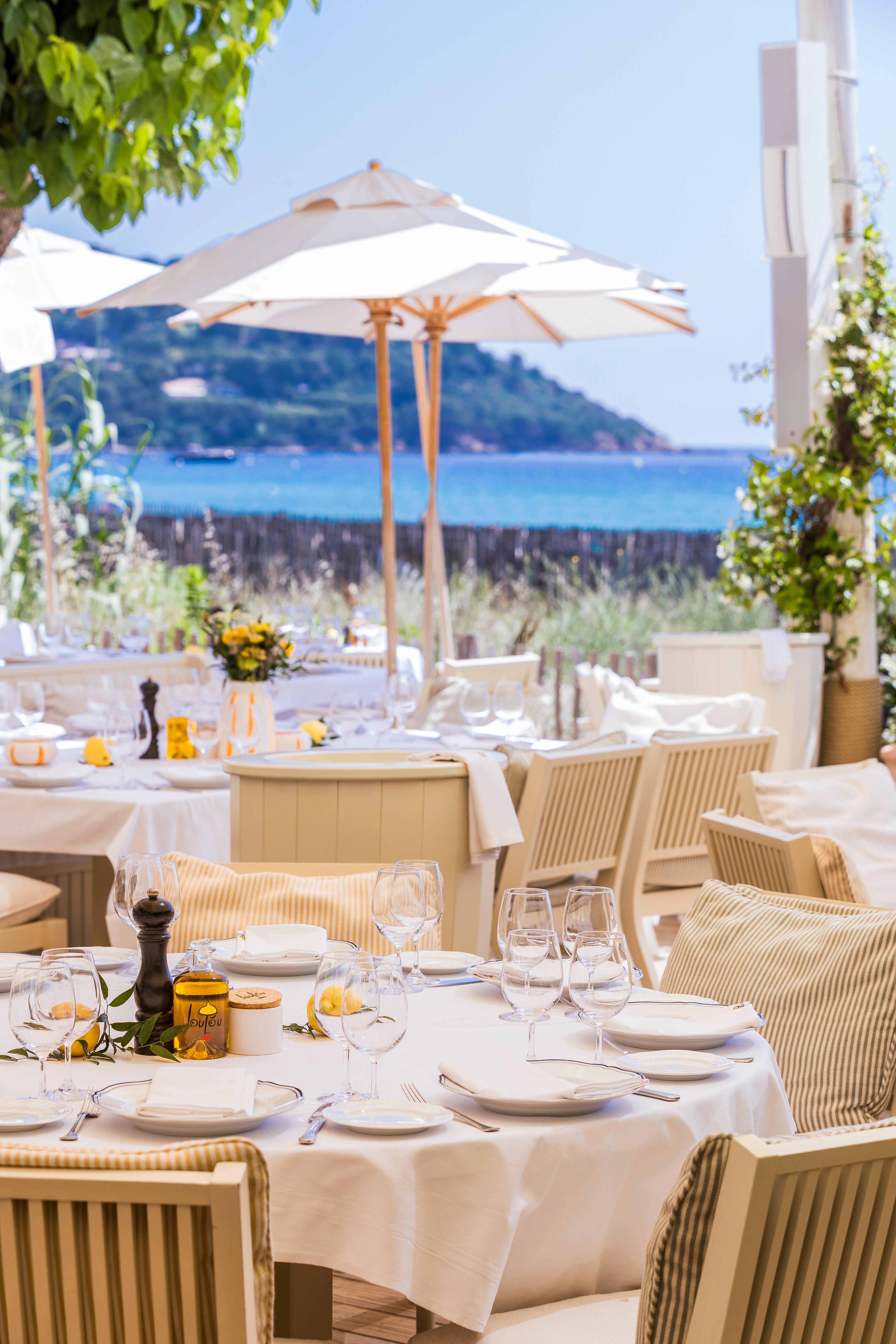
Loulou Ramatuelle is lunch-only and turns roughly 550 covers in the restaurant on a strong day, plus another 100 on the beach sunbeds, with about 85 people working across the floor, kitchen, shop, valet, and boat on any given day. Additionally, one of the bigger line items, unsurprisingly, is maintenance capex on the building as its proximity to the sea causes saltwater corrosion.
Alexandre quotes James Sherwood, who built what became Belmond, on the wisdom of betting on sunny destinations where weather isn’t a variable. The South of France delivers a low and consistent count of rainy days, so over a short season it barely moves the needle. Courchevel, he notes, is a different story. But for the Mediterranean sites, weather is not the thing that keeps him up at night.
Staffing is a challenge for every hospitality operator, but seasonality adds a layer of complexity
What keeps him up is staff. “The season starts fast and there’s no real warm-up period,” Alexandre said. The team has to be at full standard within a couple of weeks, with no gentle ramp to get service right, which is why Loulou has spent years investing in staff loyalty. A large share of the team returns season after season, guests recognize the faces, and the group can open and close a seasonal restaurant in a matter of days because the choreography lives in people who’ve done it before. Staff accommodation goes into the model as a cost and a piece of operational complexity that a Paris restaurant never has to price.
Marc, coming at it from the market level, points at the identical line item. When he lists what actually makes a location durable, past the transportation accessibility, the anchor venues and the good hospitality, he lands on one of the most critical aspects for any seasonal business: housing for staff. “If staff can’t afford to live there, the cost of labor goes up, then prices go up, and customers feel abused.” The housing you provide for your people and the value your guests feel they’re getting are therefore the same problem to solve.
Mediterranean beach restaurants are compelling and durable businesses…if they resist the temptation to sell out
So the answer to the question the season poses, whether this is a solid business or a bet on short-term demand, is that it is durable, but the durability is a discipline rather than a location. The markets that last are the ones extending the three-month window. The operators that last are the ones who refuse to charge the absolute most people are willing to pay while delivering less value. And the thing that decides both, sitting under the margin and the guest experience alike, is whether you can properly incentivize the people who make everything work.
What compounds, in the end, is a mindset more than a market. Alexandre keeps returning to the word institution: places that, as he puts it, “feel like they’ve always been there, that can pass the test of time.” That’s the opposite of the reflex he sees spreading, operators leaning into artifice, “decor built for photos, music played too loud, lighting dimmed to hide rather than flatter,” and treating one good restaurant as a reason to expand. His position is that a great restaurant, however successful, isn’t automatically a brand, and that some of the best places are special because they’re local and were never meant to travel at all. The operators who last stay focused on the essence of good hospitality: how you welcome a guest and how well you serve them. In a market that sells a hot new opening every May, the most durable position in “Eurosummer” is held by the people building for decades rather than for the season in front of them.