

Is the future of hospitality frictionless?
With Marc Lotenberg, Founder & CEO of Dorsia

Hello everyone and happy Tuesday.
If you’re a reader of The Stanza, you probably enjoy going to restaurants that require a bit of chess to reserve, but you likely don’t enjoy the chess part. I first discovered Dorsia two years ago and found it to be a nice solution to that. I don’t love texting anyone for reservation favors. It feels a bit burdensome, and even if the operator on the other side says they don’t mind, I can’t imagine that it’s fun having your friends blow up your phone for bookings. One of my favorite use cases for Dorsia is getting direct access to places like Jondal Ibiza in July, or other impossible reservations such as Torrisi or Straker’s on a Friday at 8PM, all without asking for favors or paying cash to a random concierge person. I also love that it allows you to “dine and dash” as it stores your card information and automatically takes care of the bill, removing the awkward payment part at the end of a meal.
The solution Dorsia offers to hospitality operators is also compelling. Rather than competing on inventory like a traditional booking platform, Dorsia operates on a minimum spend model: members commit to a per-person spend in exchange for guaranteed access to venues and experiences that are otherwise nearly impossible to get into. This optimizes revenue for primetime tables and avoids the issue of giving these tables to groups that don’t order much but are there to take photos.
Beyond restaurants, Dorsia is expanding its platform to travel and events. As The Stanza continues to explore various facets of hospitality, particularly on the demand side, I’m excited to share that I’m continuing my partnership with Dorsia this year to share more on how hospitality will evolve with tech and AI.
The Stanza readers can get access to Dorsia here (code: THESTANZA).
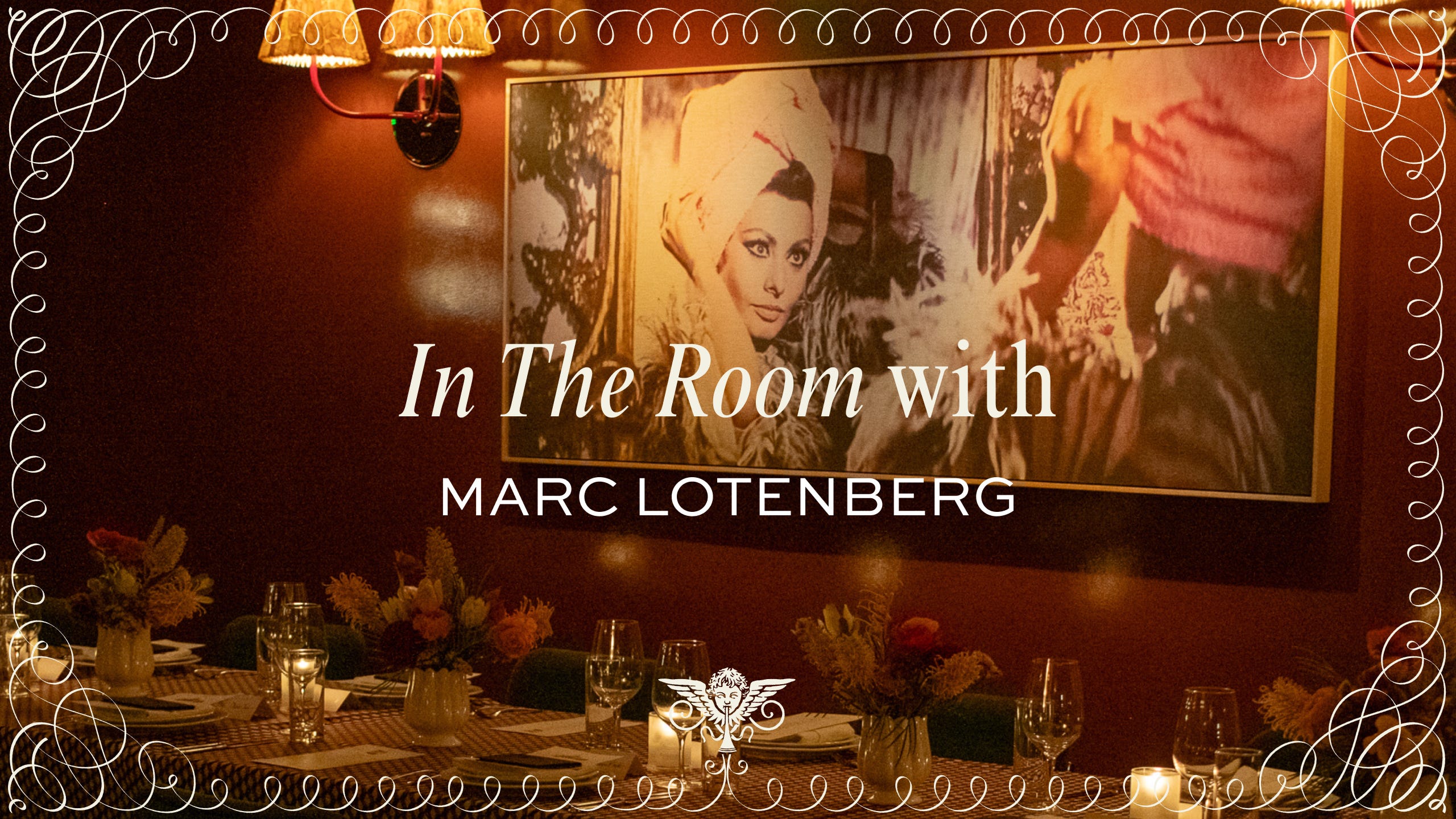
Marc Lotenberg is the founder and CEO of Dorsia. He has worked in hospitality since he was 13, moving through nearly every role in restaurants, events, and nightlife before pivoting to media, where he acquired W Magazine from Condé Nast. When COVID brought that chapter to a close, he moved to Miami and turned his attention to a problem he had been thinking about for years: why is it still this hard to get a good table? Dorsia was the answer. In February 2025, the company announced $50.4M in seed and Series A funding at a $146M valuation, led by Index Ventures, with participation from Invus Group and individual investors including Naomi Gleit of Meta, Sweetgreen co-founder Jon Neman, hospitality figures Mario Carbone and David Grutman, and operators Simon Kim and Jeff Zalaznick of Major Food Group.
There has always been an invisible economy around prime tables. You know the maître d’, you text him, and as long as you’re a regular he’ll get you in. But now you’re formalizing that, and finding a way to create value for both the customer and the restaurant. What made you want to do that, and why now?
A few things collided at once. COVID hit, restaurants outsourced so much of their product to tech companies, and the tech was really bad. They lost control of their dining room, and cancellations and no-shows are hard to avoid. And at the same time, the world was moving from restaurants doing 2,000 covers a night to 200 covers a night, but the tech was built for the old-school legacy systems. That curation of who’s in the dining room is important. Understanding how much people are spending and what they are spending it on is important. So that timing was what created the ‘magic moment’. We knew that eventually people were going to come out of COVID and there was going to be this mad dash for experiences.
And then on the unit economics side: there was all this demand, but the money wasn’t all going to the restaurants or the servers. It was leaking into this invisible economy through grey market reservation platforms. So I was looking at all that and thinking there’s a better way to do this: by curating which people should be coming in, get them to commit to a spend so that everyone can win in the ecosystem.
Social media has effectively crowd-curated the same 30 most popular restaurants in every major city. How do you see that changing the way people access these places, and what’s Dorsia’s role in the curation?
In a world where everything looks “good” as a baseline, the ultimate distinguishing traits are going to be taste and critical thinking ability. There will be a future in which the phone disappears, and the focus will be on entertaining your customer. Most of these companies with websites, bad experiences, and OTAs are gone. You’re not going to be scrolling through a list of things trying to filter which hotel, which nights, what availability. You’re just going to be talking to your AI agent, and your agent is going to be booking places based on your patterns and what you already want.
What we’re building is closer to Netflix or Spotify than to a reservation platform. It’ll be about entertaining you and bringing you on a journey, and telling you where you’re going, when you’re going, who you’re going with, why. And you’ll feel like you’re just covered.
When a restaurant or hotel goes viral, you have very little control over who comes through the door, and it can very quickly lose its desirability. You don’t want the crowd that’s there just to take a photo. You want the crowd that genuinely loves the experience and wants to support the business. How is Dorsia helping operators manage that?
Social media was almost like a death sentence to restaurants in so many ways, because it filled dining rooms with influencers going to these restaurants for social clout. They clogged up the dining room just to create content, which creates a weird vibe. And then it brought their audience to the restaurant, which is not what restaurants actually want or need. If that’s not the audience you’re going after, you’re just clogging your whole system with noise and the wrong people, and losing your point of view.
Our solution for restaurants is: one, curating the right customer for them. Two, getting them the right revenue optimization. And three, increasing the overall hospitality experience. You’re going to be walking into a restaurant soon and they’re going to know you’re approaching, your table is waiting, your glass of wine is on the table, and there’s a special menu based on your behavioral patterns that wouldn’t ever be possible without that technology. Restaurants can’t build this themselves. They don’t have the tech infrastructure. Someone who really understands hospitality has to build the apparatus for them, so they can focus on the entertainment, the show, the theater.
Dorsia has an application process, which is an interesting component of the product and the experience. Walk me through how that works. How do you decide who gets in?
It’s not just in or out; we use degrees of separation and connectivity points. When I was promoting back in the day in high school, I was literally collecting names and addresses, building charts by schools. It was about the quality of your black book. Then email came along and it became about volume. All that did was dilute the quality of the outreach. The whole point of digital was supposed to be precision, and we lost control of that.
We’re about to come into the era of ultimate precision and personalization. For the hospitality tech companies that have cleaned and sanitized their data, and know how to curate a crowd, winner-take-all models are about to occur. For us, we’re focused on ‘top of pyramid’. We’re not everything to everyone. We don’t do any paid marketing. It’s all through degrees of separation, people nominating their friends, and those friends nominating theirs. When we bring the social components into Dorsia later this year, you’ll be able to see your circles and your connectivity points, and we’ll help you connect the dots on who you should be having dinner with when you’re both in the same city.
How would you describe the typical Dorsia member?
It’s hard to put a specific person to it. It’s people who appreciate nice things and don’t mind spending money on experiences. They appreciate the acts of dining, relationships, community, and meeting new people. We’re not the best app for the homebody who wants to eat at home six, seven nights a week. We cater to people who want to live life and experience our version of what living life is.
It’s more about a state of mind than a specific person. We have people that are 21 years old using the app and people that are 81. We have grandfathers, sons, and grandsons all using the app, and the referral chain often goes in unexpected directions. When you watch the trees of how these people are connected on screen, it’s pretty remarkable.
Let’s talk about the founding story of Dorsia. Was there a specific moment that inspired you to start the business?
I bought W Magazine from Condé Nast, and by the time COVID hit I was done with media and print. I moved to Miami and started talking to different hospitality groups. And I kept coming back to the same obsession: a dinner reservation is such a pain to get. Even when I wanted to go somewhere, I had to text owners and ask favors, and I always felt weird about it. As an owner, you want people like that in the place. But then they feel weird texting you, and you’re getting blown up on your phone all the time. No one’s happy with the outcome.
I started working through the model with Simon Kim (Founder of Gracious Hospitality, Cote and Cocodaq) early on. He got it immediately and understood we needed to bring Major Food Group on board to make the launch work, and he helped make that happen. When they joined, it really accelerated everything.
And when I went out to raise money, I didn’t even have to ask. Friends who had never put a penny into anything I’d done in media were calling me: “I’m in. Will you take my money?” That told me it was clearly a problem affecting a lot of people.
The name. I love the reference.
The second I saw it I knew that was it. But nobody wanted me to use it. I went to a top PR agency and their executive team said they wouldn’t work on the account if we kept it. The owner texted me afterward: “Look, I can’t take the account, but if you’ve got strong intuition about it, go with it.” Every single co-founder told me not to use it. I had such a strong intuition about it from the start. And I think that’s so important. Hospitality is going to be about whoever has a really strong point of view and conviction.
If you had to boil it down to its core, what problem is Dorsia solving?
Access, removing friction, and personalization. Those are the three. The part we haven’t fully solved yet, but are aiming for this year, is who you should be spending your time with, where you should be spending your time, and when you should be going. When we nail that, it’s going to change your entire outlook on what you think a tech platform can be.
There’s a version of this story where a platform like Dorsia could replace the maître d’ and the human layer of hospitality with a tech product. What’s your take on that?
Right now, maître d’s are looking at us like: I don’t know if you’re my friend or my enemy. What I can assure you is that in a short order of time, they’re going to look at us as their most important tool. We can’t do what they do. There’s a complete art to it. They’re personable, they remember everything about the customer, they speak multiple languages, they know how to read a room. That’s not tech-based. What we’re going to do is give them the ability to really shine and be the best versions of themselves they’ve ever been able to be. That’s when they’re going to say: I cannot perform at this level without Dorsia.
And I’ve seen what happens when that changes. There are restaurants I’ve been to that I loved, partly because I had a great connection with the maître d’. When that person left, the food didn’t change, nothing changed. But the welcoming changed, and that magic changed a bit. That role is going to become so incredibly important. Every restaurant is going to need a high EQ, relationship-based person there, who’s part of the show and welcoming guests. We’re not here to replace that in any way, shape or form. We want to be the tools that help them do the best they can consistently.
Thanks for reading this interview. For more of The Stanza, subscribe to the weekly digest and follow on Instagram.
I'd push back on the core premise that spend commitment is a meaningful proxy for the right guest.
A minimum spend floor tells you someone has money. It doesn't tell you they care about the food, know the team, or will ever come back. The repeat guest who comes in on a Tuesday, orders whatever the kitchen is excited about, and brings three friends the following month — that person is the actual lifeblood of a restaurant. Dorsia's model doesn't surface them. It just replaces one transactional guest (the influencer) with another (the wealthy one-timer).
There's also something worth naming about the old system Lotenberg says he's disrupting. Knowing the maître d', having a relationship with the owner — that access was earned. It was relational. What Dorsia is doing is formalizing the grey market it claims to replace, just with a cleaner UI and VC backing.
The honest pitch is: Dorsia optimizes primetime revenue and reduces no-shows. That's a real and valuable thing. But dressing it up as taste curation or 'the right crowd' is a stretch. Spend and taste are not the same thing, and conflating them is exactly the kind of thinking that's been hollowing out genuine hospitality culture for years.
On the making “relationships systematic and scalable” point I believe we need to embrace serendipity a bit more in the industry. One thing is curating, another is over-calculating. One of the aspects that made restaurants and hospitality great 20 years ago was the diversity of people that could access certain places. In some ways, it felt flatter (think Chelsea Hotel in the 70s). Yes, choices can be empowered by data, but if you over-calculate you can end up with what seems to be a diverse clientele that ends up being absolutely homogeneous in spirit.